Legal Risk Analysis
Novo Nordisk is currently facing a significant number of lawsuits in the United States related to its GLP-1 drugs—Ozempic, Wegovy and Rybelsus. These drugs have been associated with adverse effects such as gastroparesis (delayed stomach emptying), persistent nausea, gallbladder complications, and vision issues like non-arteritic anterior ischemic optic neuropathy (NAION). Emerging clinical evidence also suggests that these medications can lead to a reduction in lean body mass, including skeletal muscle and cardiac tissue. Loss of muscle mass, particularly in the heart, raises concerns about long-term safety in certain populations, especially older adults and patients with pre-existing cardiovascular conditions.
As of mid-2025, over 1,600 federal cases have been consolidated into a Multi-District Litigation (MDL 3094) in Pennsylvania. A key procedural hearing (called a Daubert hearing) is scheduled for May 14, 2025, where the court will evaluate the scientific reliability of expert testimony on causation. State-level lawsuits are also emerging, particularly in New Jersey, where plaintiffs are focusing on vision loss cases. In Canada, a proposed class action is in progress, and the European Medicines Agency (EMA) has updated drug labels to reflect a rare but confirmed risk of vision loss.
No trial dates are set yet, but initial bellwether trials may begin in 2026 or later. Settlement estimates range widely, from tens of thousands to several hundred thousand dollars per case, depending on severity and causation. While no major financial penalties have hit Novo so far, the legal pressure poses a medium-term risk.
Competitive Landscape
Novo Nordisk is a leader in the GLP-1 drug market—but competition, especially from Eli Lilly, is intensifying. The GLP-1 segment, used to treat type 2 diabetes and obesity, is rapidly growing and expected to exceed $150 billion by 2030. Here's a table of the competitive field:
| Company | Diabetes Drug(s) | Obesity Drug(s) | Notes |
|---|---|---|---|
| Novo Nordisk | Ozempic (semaglutide), Rybelsus (oral) | Wegovy (semaglutide, higher dose) | Market leader; expanding capacity and pipeline (e.g., CagriSema). |
| Eli Lilly | Mounjaro (tirzepatide) | Zepbound (tirzepatide) | More effective in weight loss trials (~20% vs. ~14% for Wegovy). |
| Amgen | — | MariTide (GLP-1/GIP fusion, Phase 2) | Monthly injection; early trials show ~20% weight loss. |
| Pfizer | — | Discontinued Danuglipron (oral GLP-1) | No current GLP-1 drug; pipeline setbacks due to liver concerns. |
| Others (BI, etc.) | — | Survodutide, Pemvidutide (in trials) | In early-stage trials; could offer lower-cost or more convenient options. |
Despite Novo's current dominance, Lilly (NYSE:LLY) is gaining market share quickly, and its drugs have shown superior clinical outcomes. Other pharma companies, while behind, are developing potential alternatives that could disrupt the space if proven safe and effective.
Insurance reimbursement and public health coverage are growing concerns. US insurers require strict conditions for covering these drugs, and government plans like Medicare only cover them under specific diagnoses (like cardiovascular prevention). Outside the US, coverage varies widely, limiting international expansion.
Operational and Financial Risks
Novo Nordisk has heavily invested in expanding its manufacturing capacity. Recent acquisitions and new production sites such as the $16.5 billion Catalent deal aim to meet demand, especially for Wegovy.
Hims & Hers Partnership Termination
In June 2025, Novo Nordisk ended its collaboration with Hims & Hers, citing the sale of "knockoff" versions of Wegovy by the telehealth company. Novo Nordisk alleged that Hims & Hers sold compounded semaglutide products manufactured in China and not inspected by the FDA, posing safety risks to patients. This move sent Hims & Hers' shares plummeting over 30%, as the company had anticipated more than $700 million in revenue from weight-loss services, a target now in jeopardy without Wegovy sales.
The termination of this partnership highlights the challenges Novo Nordisk faces in balancing accessibility with regulatory compliance. While the company aims to expand access to its products, it must navigate the complexities of distribution channels and ensure that all partners adhere to stringent safety and legal standards.
However, these capital expenditures increase costs in the short term and may impact margins. Despite rising costs, Novo maintains high profitability. In 2024, the company posted a gross margin near 85% and an operating margin around 44%. Revenue grew by over 25%, driven by GLP-1 demand. However, Novo's 2025 guidance is more cautious, reflecting increasing competition, pricing pressure, and higher R&D spending.
Technical Insights
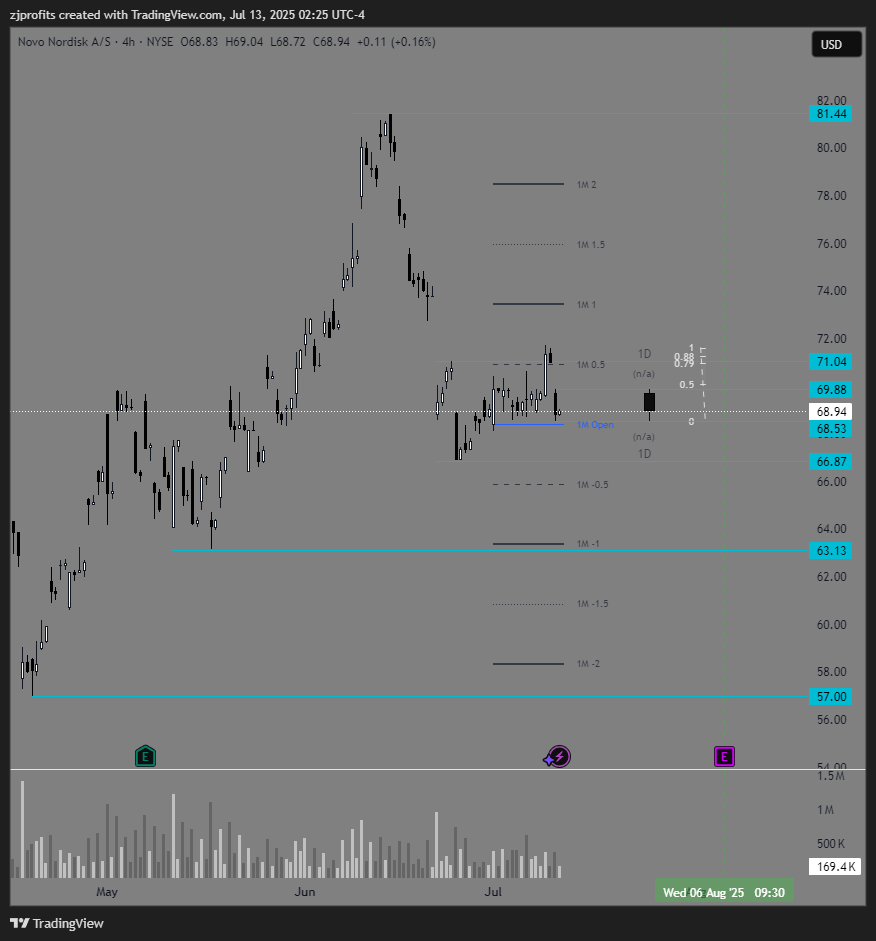
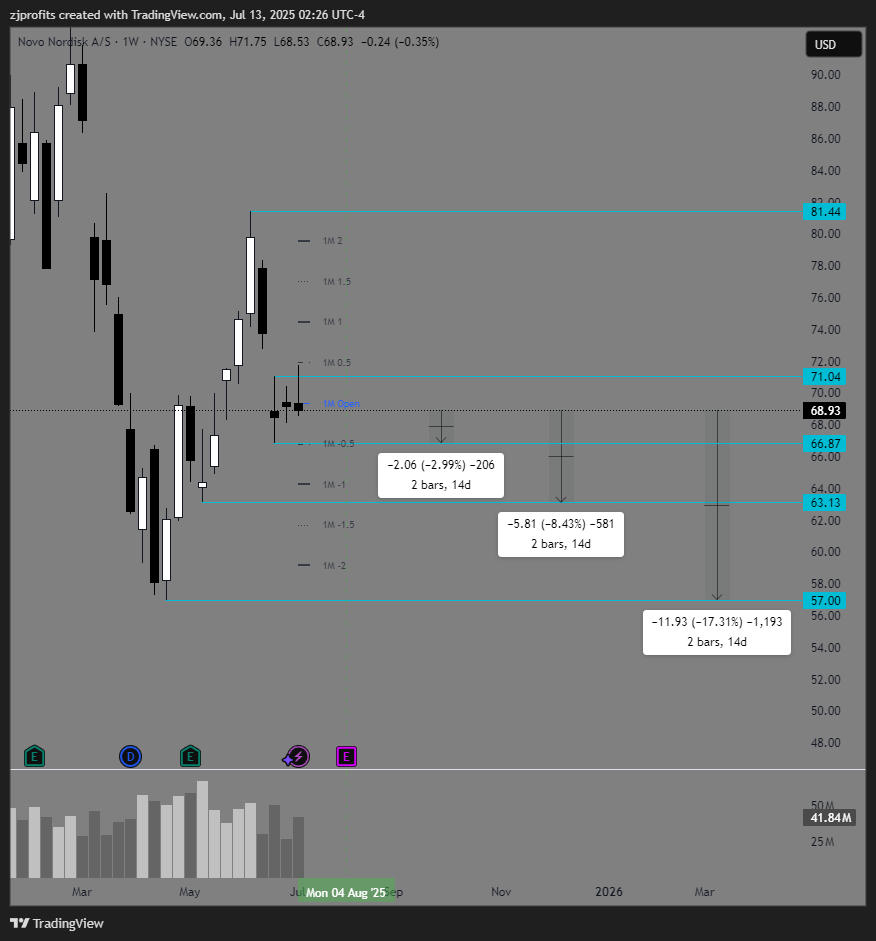
Technically, the outlook is bearish. Both the weekly and daily moving averages are trending downward, reinforcing negative momentum. The recent weekly price action rejected the 0.5 standard deviation based on the monthly timeframe, resembling a Wyckoff spring. A weekly close below $68 would confirm that sellers have taken control.
On the 4-hour and weekly timeframes, key levels to watch are:
| Level | Price | Notes |
|---|---|---|
| Current Price | $68.94 | Jun 2025 |
| Confirmation | $68.00 | Weekly close below confirms seller control |
| Target 1 | $63.13 | ~8.4% downside from current price |
| Target 2 | $57.00 | 52-week low, ~17.3% downside |
These levels represent realistic downside scenarios if bearish pressure continues.
Summary
Novo Nordisk remains the market leader in GLP-1 therapies but faces increasing headwinds from accelerating competition, notably from Eli Lilly, and growing legal risks related to its drugs' safety profile. The recent termination of the Hims & Hers partnership highlights operational challenges in distribution and regulatory compliance. While financials remain strong with solid margins and revenue growth, cautious guidance reflects market saturation risks and rising costs. Technical analysis indicates bearish momentum, with price levels suggesting potential downside in the near term. Investors should carefully monitor legal developments, competitive dynamics, and supply chain issues when assessing Novo Nordisk's outlook.
This document is for informational and educational purposes only and does not constitute financial, investment, tax, or legal advice. It is not a recommendation or endorsement to buy, sell, or hold any securities or investments. Readers should conduct their own research and consult with a qualified financial advisor before making any investment decisions. Elysium and its affiliates are not responsible for any financial losses or damages resulting from the use of this information.
← Back to Research Archive